Sunday, February 8, 2015

North Queensland - The Great Barrier Reef and Rain Forest

We thought it was hot and humid at Uluru - then we got to Cairns (that's Cahnz, mate!). Flying in, we could see the lush green and the blue water and expected a bit of relief, but when we stepped off the plane it was just as hot and even more humid than before.


We were staying in a little place called Palm Cove about 30 minutes outside of Cairns. Georgina said that they used to stay at Kewarra Beach, about 5 minutes closer, but apparently even more remote. At least Palm Cove has a little shopping area and a few beachside restaurants. The Reef House started life as a private home built by a bookie (in case we haven't mentioned it yet, it seems that the Aussies come in second only to the Chinese when it comes to gambling) in 1958. He apparently got 'the best swimming pool in north Queensland' as debt repayment by a swimming pool builder. It was purchased by a retired Brigadier in 1972, who expanded the number of rooms but still maintained that private guest atmosphere. Here are a few pictures from around the resort:

Reef House at Palm Cove


Our room

Our terrace, complete with counter, wet bar and fridge, overlooking the pool

The freshwater pool; they also had a saltwater pool

The beach across the street


We had the rest of the afternoon to relax a bit. Working on a blog post was on the agenda, but we found that the internet access was really spotty (non-existent, actually), which is apparently not unusual in the area, so not only were we not able to post, we couldn't even access e-mail. Not a huge concern for us, but some of our fellow travelers spent quite a bit of time in one area or another trying to connect.

A quick word on the area we were visiting. It is actually where two World Heritage listed areas meet - the Wet Tropics of Queensland World Heritage Area and the Great Barrier Reef. If you can handle the humidity there is a huge list of things you can do. We keep forgetting that this is the height of summer, and most Aussies, when they visit (and many do), will come in their winter instead, when the weather is more reasonable and warmer than in Sydney, Melbourne or Brisbane.

On Monday morning we headed out for our day on the Great Barrier Reef. Many of us had really been looking forward to this as one of the highlights of the tour. We drove for about 45 minutes along the coast to Port Douglas and boarded one of the Quicksilver Wavepiercer Catamarans headed for their permanent pontoon at Agincourt Reef.

One of Quicksilver's other catamarans. You can see why they're
called 'wavepiercing'. Each of the pontoons even has a
bulbous nose to cut the waves.

The catamaran is quite large and comfortable, and Tauck tour members had the added bonus of being able to board about 1/2 hour before the rest of the masses and get a private talk from one of the marine biologists on board. It may not sound like much, but when you realize that there were about 400 people on the boat, and it was almost impossible to hear the biologist's presentation while underway, it was a real advantage. The trip out to the reef took about 1 1/2 hours, as the Agincourt Reef is one of the outer reefs. Not more than 2 km out from there, the ocean depth drops from 10-20 meters to 500 metres and then even farther, as it is at the edge of the Australian continental shelf. The pontoon, when we arrived, was quite impressive. This was where all the diving and snorkeling equipment was stored, lunch was served, and everyone could access the water.

This is a photo from the brochure, showing the catamaran docked
to the pontoon, the various swimming and water access points,
and one of the semi-subs.

Larry, who likes to be able to touch bottom when he swims, stayed on board the catamaran and pontoon, but Monica went on the marine-biologist led adventure snorkel. Here are some of the photos she took:


We did get Larry into the water, sort of. Quicksilver also had an underwater viewing area and 3 semi-submersible boats, like the ones that many Caribbean islands have, that allow passengers to see the reef through large underwater windows on both sides. The rides lasted about 20 minutes, but provided another good view of the reef:


In total, we had about 4 hours out on the reef, and our catamaran departed for Port Douglas at about 3:00. The weather, and the seas, were still good for the whole trip back. It wasn't until we were underway back to Palm Cove that the heavy clouds moved in.
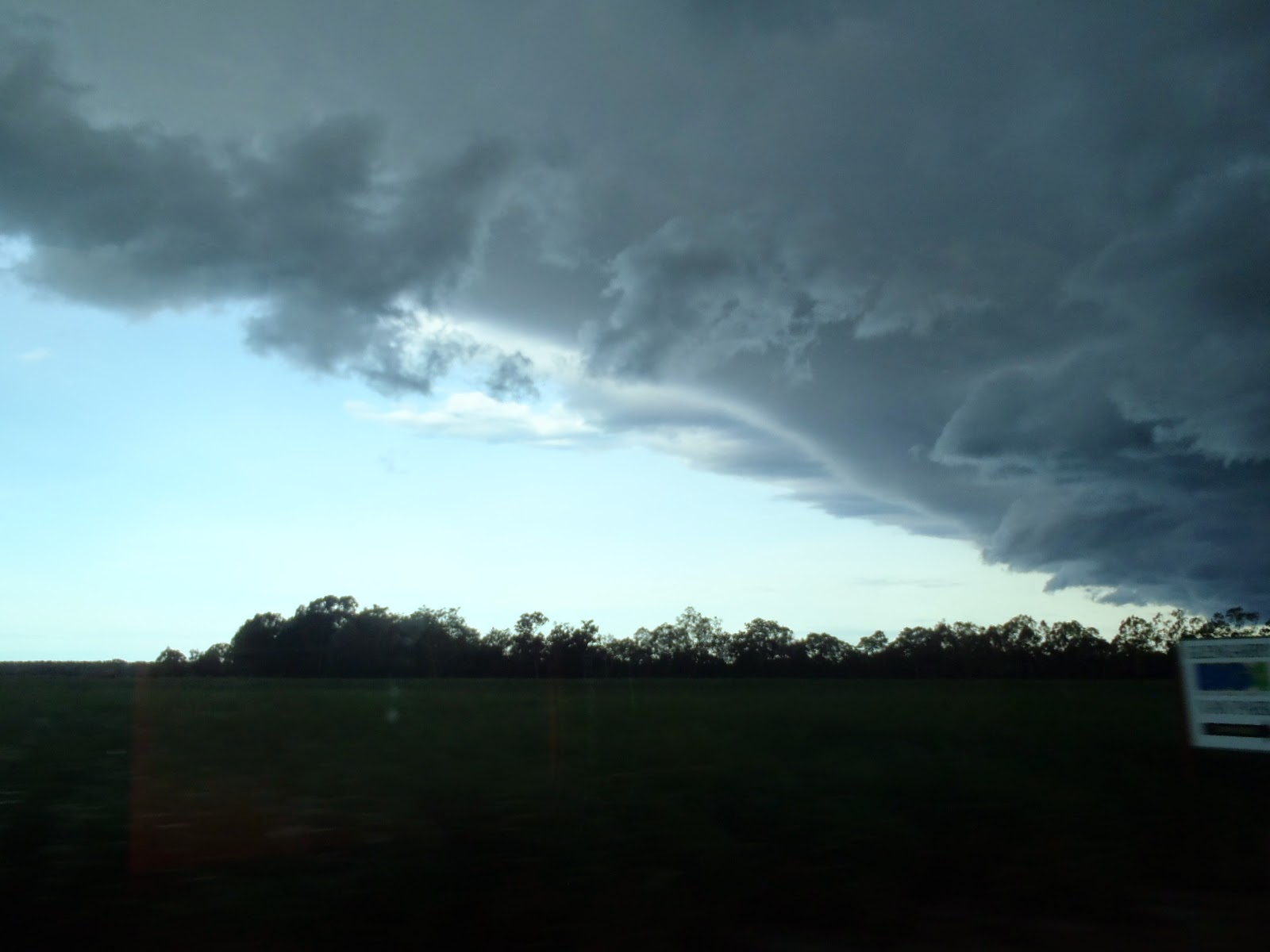


We drove through quite the downpour on the way back, but by the time we reached Reef House it had all but stopped. It had been quite a day. We managed to have dinner and then crashed early after trying once more to get on the internet for e-mail. When that didn't work, we used Monica's phone and sent a quick message home, just so everybody knew we hadn't been eaten by a Great White Shark!

Tuesday was another busy day, being our in-depth trip to the tropical rain forest. Promptly (and we must say that all 40 of us were always very prompt!) at 9:00 we departed for Kuranda, known as the village in the rain forest. The village itself was established in the 1980s by some artists and leftover 'flower children' who wanted somewhere that they could commune with nature but still earn a living with cafes, galleries and other shops. Nowadays it is a somewhat larger village and also has places where you can visit Butterflies, Birds, Reptiles, Kangaroos and Koalas. The big draw is the Koala visit, since Queensland is one of the few Australian states where tourists are still allowed to hold Koalas. In most other places you can stand beside one, and maybe touch it, but not hold it. Here are a few pictures of that visit:

Monica having a cuddle with Fred

Who knew that Koalas did anything but sit in trees, eat and
sleep? This guy was doing laps!!

The Kangaroo enclosure


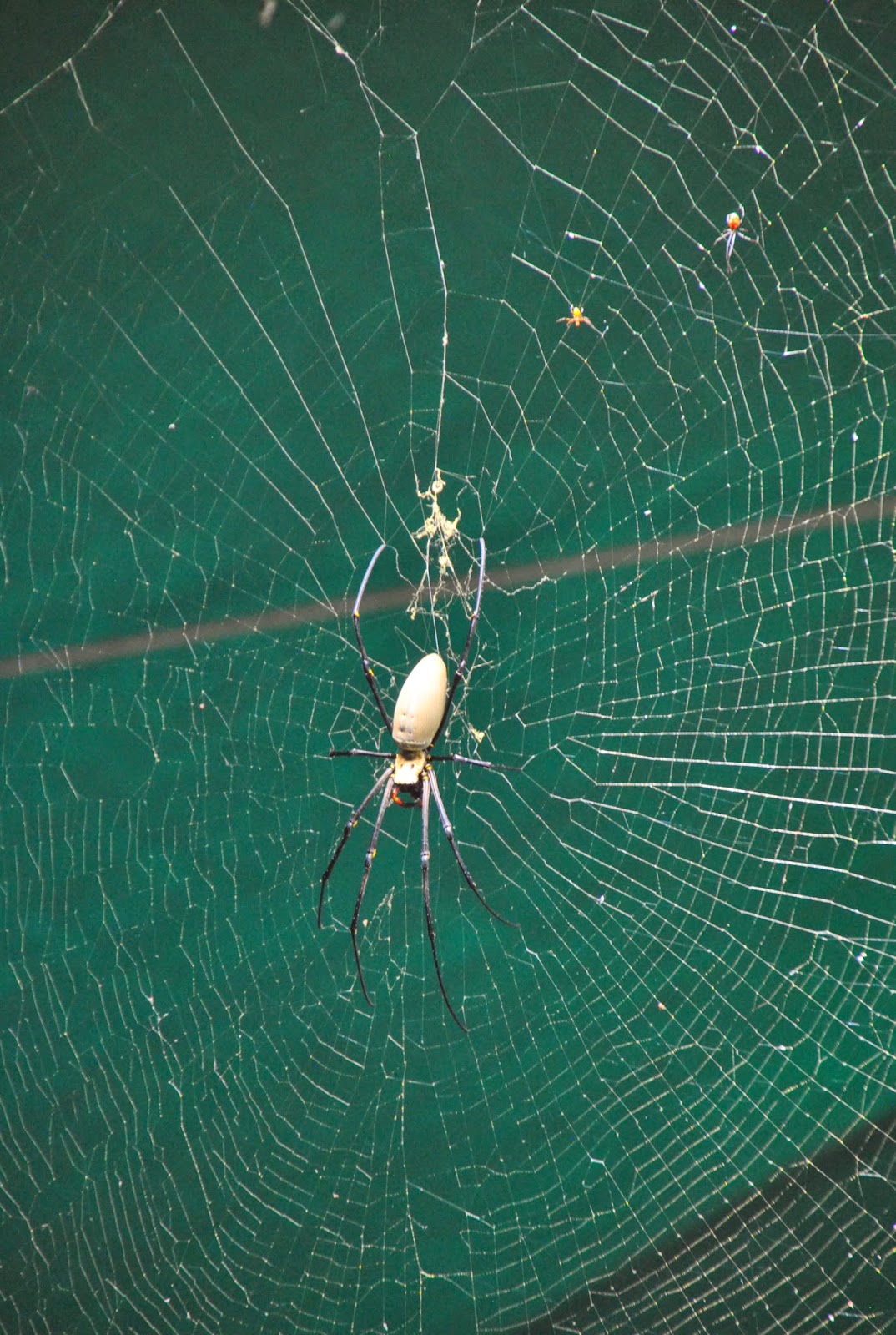
This spider doesn't look too dangerous - until you find
out that it can kill and eat birds and snakes! And it wasn't behind
glass!!!

One ugly Python! And that's without
seeing the other 8 feet of him!

Once we finished at Kuranda, we drove the short distance to the Skyrail. This is a high-level gondola ride that takes you across the rain forest canopy. It is done in 3 stages, with ranger-led interpretive walks at the 2 stations in between.


On one stage of the Skyrail, we luckily got a 'Diamondview'
gondola with a clear floor. This was the view to below. 
Glen and Joanne from New Hampshire, travelling with Joanne's
brother and his wife.

The Barron River. It was very muddy because of that
heavy rain the afternoon before.


The view over Cairns coming down from the
height of the Great Dividing Range

The Skyrail gondolas

As if that wasn't enough, we still weren't finished for the day! Once we descended from Kuranda via the Skyrail, our bus picked us up for the 30 minute drive to Hartley's Crocodile Farm. Hartley's was established in the 1950s by a couple who bought a crocodile and expanded their B&B to include croc viewing. They established a couple of large lagoons, one where the croc keepers demonstrate the abilities of these amazing reptiles, and another that is used as a breeding area. Upon arrival we were given a very nice lunch which included crocodile. Unlike the standard line, 'It tastes like chicken', Monica says it tastes like a very firm white fish, but has the consistency of veal...if you can figure that out.

In the demonstration, we met Spartacus, who is only 37 years old (crocs are known to live past 100) and will, according to the keeper, in all likelihood become the largest Saltwater Crocodile in captivity if he continues to grow at the expected rate. Here are some pictures of Spartacus and some of the ladies he lives with:

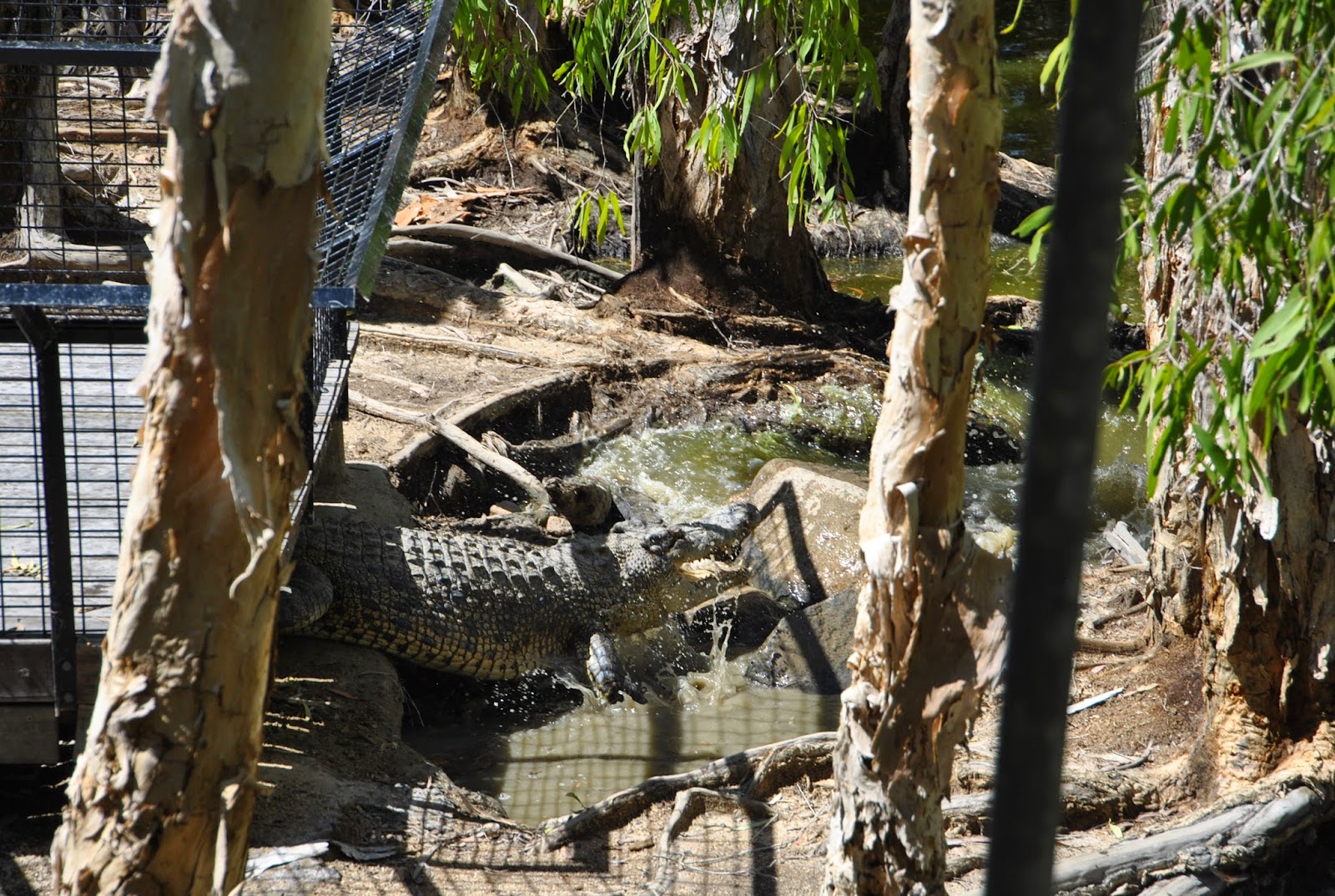
Spartacus looks scary just laying there

Look at those teeth!


Two of the females having a little disagreement

Smaller, but just as dangerous

After we finished at Hartley's we headed back to the Reef House to shower and change for the evening. We had a cultural event planned at the Tjapukai Aboriginal Cultural Centre. The Tjapukai are the local aboriginals and are very proud of their folklore and heritage. Here are some highlights from the evening:

Traditional dances to digeridoo accompaniment

A forest of digeridoos, each one different and making
a different sound

The boomerang demonstration. Did you know
that the last thing you want is to have it come back?

An intricately decorated boomerang. Hunters
only want to retrieve their boomerangs when
they're attached to game that they've been
hunting.

Not overly clear, but an outdoor demonstration of
song, dance, and firestarting.

Everybody got some tribal ochre face painting. This
was us before we washed our faces that night.
We got back to Reef House at about 9:30, and for about 15 of us, it was time for bed as we would be up at '0-Dark-Hundred' as Larry would say, to go hot air ballooning. Our actual wake-up call was for 3:00 a.m. -- we can't think of any other reason, or any other time, we have ever had to get up that early!

But those of us who were going were milling around the buffet at 3:30, having a bit of fruit, juice or coffee to tide us over until we got back and could have our full breakfast. Our pickup was on time just before 4:00 and we had a 1 hour ride to Mareeba, a town in the Atherton Tablelands, up within the Great Dividing Range of mountains that runs along the east coast of Australia. We may as well just put up some photos to give you an idea of the experience.

Inflating the balloons


Our pilot, Johan. See the setting moon in the background?

The Koala balloon

Sunrise shots


Here's a little video so you can understand just how quiet it is up there - when the burner isn't firing, that is!


Our landing spot in a farmers' field

Our balloon after it took off with the second flight.
This is the largest commercial balloon in the southern hemisphere,
with a volume of 450,000 cubic feet.

You may have noticed from the last pictures that we had landed in a farm field...of watermelons! Johan, our pilot, bumped us around a bit on the landing to jump over some of the rows of melons and avoid squashing any of the farmer's merchandise. The only drawback to our landing was that we walked back out to the road in this rusty orange coloured soil that muddied up our pant legs and got stuck in our shoes - to the point where our pickup driver stopped somewhere that we could wash our shoe soles to try to get the worst off.


We had enough time once we got back to Reef House to find a change of clothes in our luggage and have breakfast before our bus picked us up to go to the airport for our flight to Sydney. We'll pick up from there on the next post.

Saturday, February 7, 2015

Uluru and the Outback

Early Saturday morning we left the posh Langham Hotel, but not after seeing something that we couldn't resist taking a photo of:  two guys cleaning the flies on the Eureka Tower. Huh? you say, flies? Well, the building design is related to mining - the gold colour on the top windows represents the gold mined starting in the mid-1800s, and there is a red stripe hanging down from it representing the blood that was shed when miners rebelled against usurious rents for their homes and had a skirmish with police (that ended up changing the law, by the way). It wasn't until we started writing this blog post that the relevance of the bugs on the lower part of the building, which we had been looking at from our elevator lobby for two days, came to us. There are lots, and lots, and lots of flies in the Outback and mining areas. They don't bite, but they are quite the pest. They couldn't have designed a building devoted to miners without including these guys; and here's the photo:


After breakfast we were driven to Melbourne's domestic airport where we boarded our private chartered Fokker 70 jet that would take us to the Uluru Airport. Private chartered meant no security, no restrictions on carry-on, and no full-to-the-gills plane! Wow!!!

With a minimum of muss and fuss we loaded up and headed out. We were flying Alliance Airlines. Larry spent some time talking to one of our two flight attendants, and she explained that this was a strictly charter airline, mostly used by mining companies to ferry miners back and forth between the mines and their home cities around the country. As mentioned before, Melbourne was established and grew as a result of the discovery of huge veins of gold in the south. Well, the gold wasn't restricted to just that area, but can be found almost all over the country. In fact, Australia still has the largest amount of unmined gold reserves in the world. And mining is a huge industry, especially in the interior. We couldn't quite understand why the inflight magazine was called 'Rocks' and had lots of information and ads directed toward miners, until we got this information.

It was quite cloudy in Melbourne in the morning, and we climbed through the clouds almost immediately after taking off, but the effects of the ocean wore off quickly; the clouds disappeared, the terrain flattened out and everything seemed much drier. Here are a few photos from the plane:


The flight took 3 1/2 hours, about the same as a flight from Toronto to St. Maarten, and we were only going into basically the geographic centre of the Australian continent! Once we arrived and stepped off the plane, we were greeted by a wall of heat and humidity. It had only been about 21°C in Melbourne; at Uluru it was already 36° and nobody said anything about humidex! Apparently we got a bit of a break, since Georgina said they had been expecting 40°.

We met our driver, Leroy, at the airport. Georgina had told us that he was a typical non-politically correct Aussie, ready to speak his mind but not in offense to anyone. He turned out to be a real character, but extremely knowledgeable about all aspects of the history, the geography, the cultural significance of Uluru and the aboriginal people who have depended upon it for thousands of years.
While our bags were being taken to our hotel, the Sails in the Desert, Leroy drove us around for an introduction to Uluru, or Ayers Rock. He explained first that there is no really good reason for it being called Ayers Rock. An Englishman had come out and inspected and 'catalogued' the rock, but the only name he got for it from the aboriginals was 'Uluru'. He figured that nobody would understand that name, and since he wanted to get some funding for the work he had done, and might do in the future, he decided to name the rock after a rich and somewhat famous person. The first one he thought of was one Henry Ayers, who fit the bill perfectly, so the 'English' name for the rock became Ayers Rock. It wasn't until the 1980s that everyone started calling it by its traditional aboriginal name of Uluru. It is pronounced with the emphasis on the first 'U' - OO-lu-roo - for anyone who wants to know, and there is no translation for the name. People have said it means 'meeting place' but that's not accurate; it is a place where aboriginal 'countries', similar to tribes, have met for 20,000 years or more, but that's all.


Now, Uluru stands about 1,530 feet high, about the same as the CN Tower, and its claim to fame is that it is one single huge rock. But the rock is actually standing on one end. The other end of it is 3 miles underground! So, as Leroy had us vacationers trying to do some mental math (you can imagine how that worked out!) we determined that only 1/15 of its total length is showing above the ground. So this is one monster of a rock! The walk around the base is about 6 miles. How did it get here, you may ask. It is a common belief among geologists that the rock was pushed up during a massive earthquake caused by shifting in the earth's plates some 50,000 years ago. At the same time, the Australian continent hadn't yet been pushed up from beneath the sea. There is evidence of this from some of the sea fossils and shells that have been found in central Australia, not only by scientists, but by aboriginals, who of course wouldn't know what they were, not having ever seen the sea. Eventually the land was pushed up and the ocean retreated, but not before Uluru had been sticking up for quite some time. Erosion in the lower sections and some of the cavelike horizontal cuts are evidence of this.

Leroy took us back to the resort where we got checked in (no unpacking necessary - we were only staying one night) and spent some leisure time at the pool. We would be heading back out to a sunset viewing area for a cocktail and canape reception, and, hopefully, some really nice sunset photos.

Sails in the Desert, Main Building


It is quite amazing that so many people are interested in watching the sun set over a rock in the middle of nowhere! Not only were we there, but at least 4 other organized tour groups as well as a whole bunch of individual travelers. Of course, Tauck got the prime spot at the end of the row with a shady covered area for anyone who needed it. The temperature hadn't gone down much, but there was a bit of breeze to keep the humidity under control as well as the flies. We talked about flies earlier - one of Georgina's offerings in our travel packs was a fly net to put over our heads so that the flies wouldn't get into our mouths! Fortunately, we found that we didn't need them here - they would only interfere with the eating and drinking anyway. We had watched the clouds build over the course of the afternoon (not really a usual thing, but some clouds always help to make a sunset), and hoped that the breeze might blow some of the them away. Unfortunately, we didn't get rid of enough of them soon enough, and the beautiful, multi-coloured sunset we were looking for became a bit of a washout instead. As Larry has been saying, 'Now we know what happens when we arrange a sunset party and the sunset doesn't show up.'  Let's see if we can make them a little more dramatic than they actually were:


....don't all these people have anything else to do in the evening?


Playing with photo editor sure makes things look more dramatic

How do you like the 'fly net' fashion statement?
Of course, not getting the gorgeous sunset we were looking for just means that we'll have to come back and try our luck again! We headed back to the resort for dinner and a bit of down time. We were expected to be up and at the bus by 8:30 for the morning's tour: 50,000 years of history condensed into 3 hours!

Sunday morning, of course, dawned without a single cloud in the sky. Doesn't that figure!
We had been given the basic geological history tour of Uluru on Saturday; we were now heading for the cultural history tour. We had had a very brief stop at the aboriginal cultural centre at Uluru on Saturday afternoon where we had the opportunity to familiarize ourselves with aboriginal history, but now Leroy put 'faces to stories' as it were as we walked some of the paths on the opposite side of 'the Rock' from Saturday's drive. Speaking of walking, one of our tour mates, Jim, was a great one for being active, so he had arranged to take the early morning shuttle bus out to Uluru, and walked the path ALL THE WAY AROUND it, a total of 6 miles! He met up with the group at our first stop.

Some of the geological features that were caused
by water but now have cultural significance
to the aboriginals


Leroy trying to draw an aboriginal story in the sand. He complained
that the only bad thing about William & Kate's visit was
that the government had the pathways packed down so hard that
he can't draw properly!

These cave drawings are between 1,000 and 2,000 years old and were
the first 'written' communications between aboriginals. They still
don't write, believing that writing things down will reduce
the importance of the older generations in passing down legends
and skills to the younger ones. 
Leroy has been driving and guiding tours around Uluru for over 20 years. He knows the local aboriginals very well and has a quirky but memorable way of presenting the stories of Uluru to the likes of us so that they and their meaning won't quickly be forgotten. Leroy is so well thought of that last year during William and Kate's visit he was their tour guide at Uluru!

The aboriginals used stories to pass on their values and morals between generations, and many of those stories have a basis in the markings around Uluru. There are over 1,600 'countries' or individual aboriginal groups, each with its own language, but because they all came to Uluru at certain times of the year, they also all had the same bases for their cultural mores. Leroy also explained how the hierarchy worked. The Grandmother was the one who made all of the social decisions, including who would marry whom; the men went out to hunt to ensure that there would be food. In each family, the grandparents were responsible for rearing their grandchildren, and the grandchildren were responsible for taking care of their grandparents. This was because the 'grey-hairs' were known to have all of the knowledge that the young people would need to learn in order to survive. One of the very interesting aspects of how these countries all got along with each other was the way that marriages were arranged. The elder woman of the family would make 'marriage deals' for her grand-daughters, but only with certain other countries. It was forbidden to marry within your own 'country'. This improved diplomacy and relations between families that might otherwise have fought each other, and at the same time reduced the number of people in one family or country that would be dependent on its hunting, gathering and food management abilities.

The Snake drawn up on the rock came to attack the
Lady Python. She killed him to protect her eggs and
take revenge for her family, and now can be seen keeping
guard below.


We made a stop at a small lake in the shadow of the Rock. It didn't look like much, but to the aboriginals it was very important, so important that swimming in that lake was not allowed on penalty of death. Why? Because it was the primary source of drinking water! But one story Leroy told was that, if a country came to the lake and for some reason it was dry, the grandmother would tell everyone to go away while she worked her magic. What she didn't tell the young ones was that there is actually a very large lake at the top of Uluru that holds huge quantities of water after rainstorms. She would send a few men (women were not allowed to climb Uluru) to open dam gates at the top and let water flow down into the lake, they would then close them to preserve water. When the children came back and found that there was water, they would believe their Grandmother to have magic powers. This served to reinforce the understanding that the elders had much to teach the young ones and that they should pay attention and learn.

The drinking water lake

Don't look like much, but they worked!

Here we are with Leroy

This looks like an aboriginal warrior's head facing to the
southeast. Legend has it that the country from that
region is responsible for Uluru, as in fact it is.

Once done with our tour at Uluru, Leroy took us directly to the airport where we reboarded the plane (with our same flight crew from yesterday - Tauck put them up at Sails in the Desert with us) and headed toward Cairns. This must be one of the hardest names in the English language to pronounce, unless you're an Aussie and used to dropping your r's. It comes out sounding like Cans, or maybe C-ah-nz. We were probably all on the plane leaving before we got it figured out!  But we'll leave that visit for the next posting.  Here are a couple of photos of Uluru from the air:

Our private plane