Tuesday, August 4, 2015

One Day in Scotland

Thursday morning brought us to the port of Greenock for excursions to Glasgow and Edinburgh. We wanted to see Edinburgh this time as on our previous visit we traveled out to St. Andrews. This was a popular choice, on waitlist when we pre-booked excursions; fortunately it cleared and we were able get there after all. The only disappointment was that the annual Military Tattoo wouldn't be starting for another week.

The drive from Greenock took about 1 1/2 hours, during which Monica worked a bit on previous blog entries - yes, it's been one of those trips so far - in between taking a few photos of the countryside.

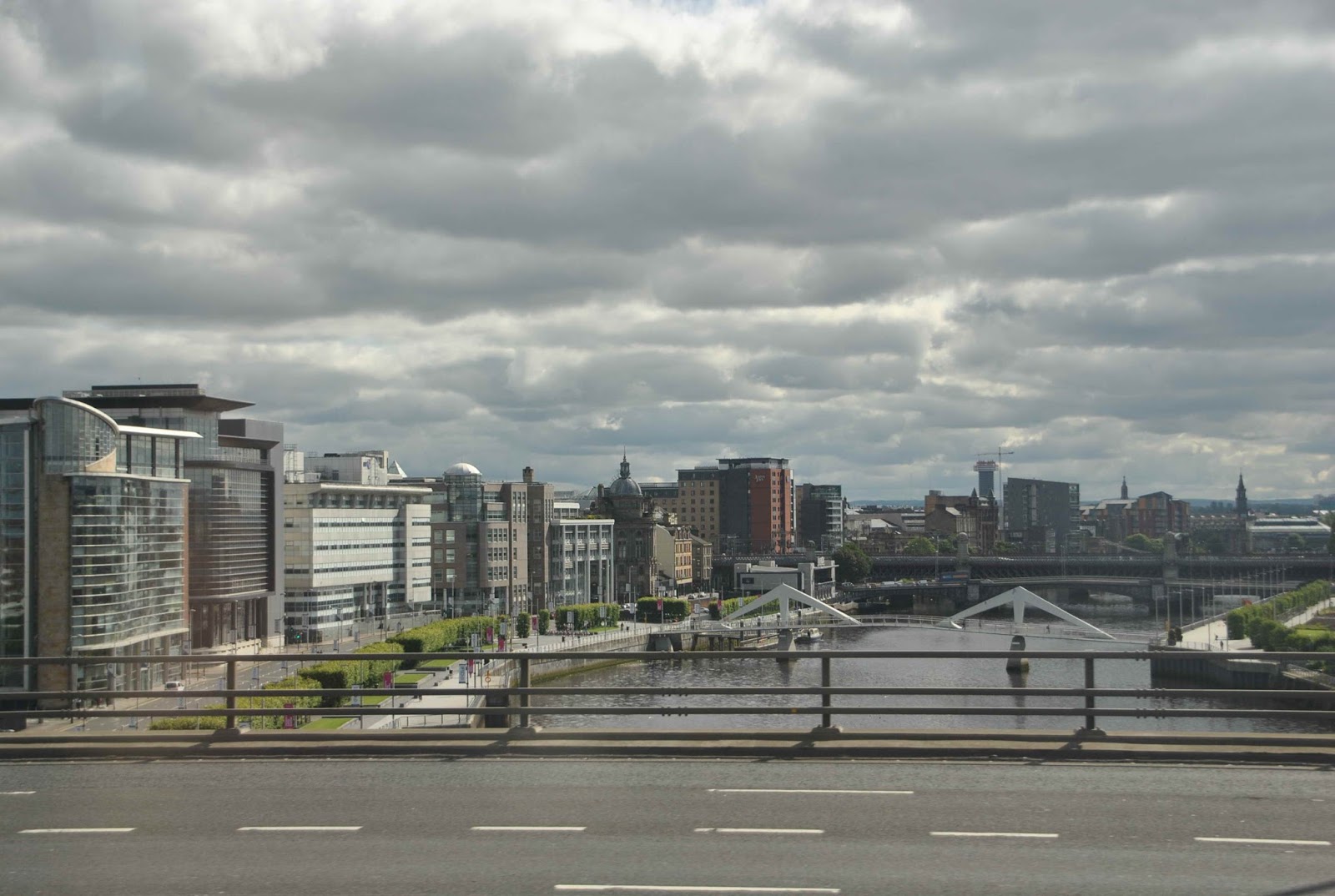
The River Clyde on the way toward Glasgow

Passing through downton Glasgow

On the way to the centre of Edinburgh, we drove through parts of the New Town (which still dates back to the 1700s) that was established as 'country residences' for the wealthy merchants and lower aristocracy. There are some lovely buildings here, but also some really nice private homes. Some of their gardens were also quite beautiful:


This building, the name of which escapes us at the moment, actually has a connection to Liverpool. Remember the design competition for the Liverpool Anglican Cathedral? Well, this building was one of the designs submitted and ultimately rejected. So, as Trish, our tour guide, said, 'Liverpool's loss is Edinburgh's gain':


Our first stop in Edinburgh was at the Palace of Holyroodhouse, the Queen's residence when she is in Edinburgh. We didn't have a lot of time to stop here, as our day was fairly precisely planned, but at least we got a good view from outside the gates.


One surprise to us was the elevation differences in the city. The Old Town, where the castle is built, is high on a hill, making it almost impregnable. The New Town was built down the hillsides and outward. The streets, of course, are rather narrow and for the most part one way, so it was quite a challenge for our coach driver to get around some of these places.


This bridge goes across the valley, not a river


The photo of the Greyfriars Bobby pub is notable not because of the building but because all the people are gathered around to rub the nose of the little dog statue out front. He is 'Greyfriars Bobby', a little dog owned by a local fireman. The fireman passed away, and the dog continued to visit his grave every day for 14 years. He became a ward of the city, with everyone feeding and taking care of him until he died, and this was the tribute Edinburgh made to him.


No economist could pass by this statue without making a comment. Adam Smith, the father of economics, in front of St. Giles Cathedral.

We walked along the Royal Mile that leads through the centre of town and up to Edinburgh Castle. Shops, pubs, whisky (the Scots spell it without the 'e') shops abound, along with street performers and some unique presentations, like this falconer:


We had lunch at Hadrian's Bistro in the Balmoral Hotel. Yes, there is a connection to the Queen - not only does she own Balmoral Castle elsewhere in Scotland, but she also owns the hotel. After that we had some free time to wander before heading to the castle. We walked along the Royal Mile, and in one whisky shop we found a product from the somewhat elusive Glen Elgin Distillery, Norm's favourite:

Sorry, Norm - a bit too expensive to bring home
for you
And then it was on to the castle.


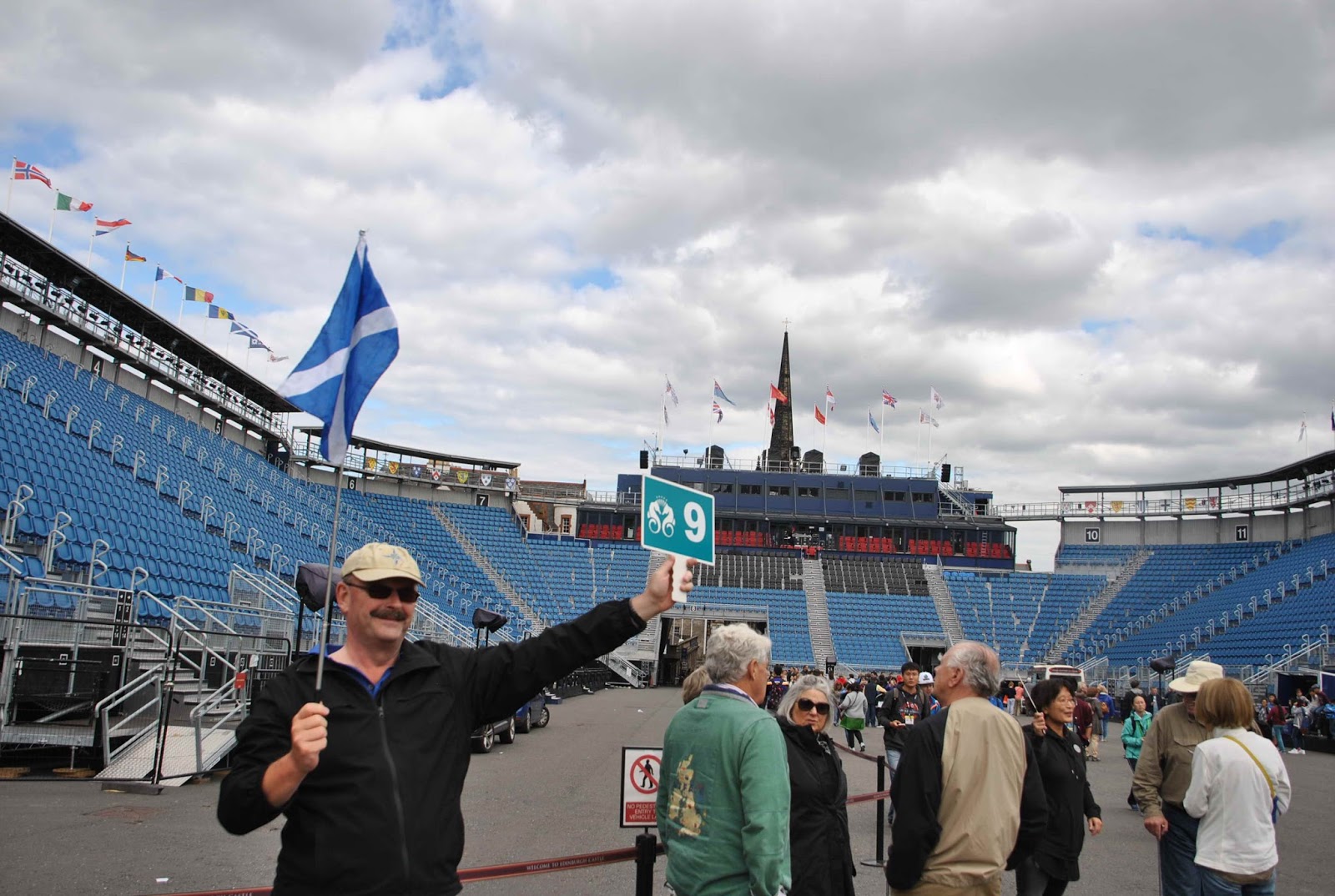
Our tour guide, Trish, was a very nice, bubbly Scot who had obviously been doing this for quite a while. The only problem was that she was rather short. To compensate, she had a retractable baton on which she flew the Scottish flag, but sometimes she needed a little help. So Larry, of course, offered to give her a hand when needed:


The castle area was quite busy, but we still managed to get around and take a few good pictures:

The National War Memorial

In the courtyard

State rooms still used today


The Great Hall, also still in use

Looking down over the city


And of course, it can't be a visit to a major historical site without scaffolding...


From the castle we headed back to Greenock, unfortunately through Edinburgh rush hour, but one good thing about Britain is that there are lots of dedicated bus lanes, especially in the cities, so we managed to avoid the worst of the traffic.

The River Clyde, like most others here, almost disappears at low tide, as evidenced by this picture taken on the way back. Compare that to the first picture in the post and you can see the difference.


It was a long day, but we were in the Sunset Bar for sailaway at 10:00 p.m.


On Friday we would be in Dublin for the first day of our overnight stay.


Liverpool - Home to more than just the Beatles

On Wednesday we arrived once again in Liverpool. We had been here before on Princess with Michel and Judy, but decided to explore the Lake District on that trip. This time we were determined to see something of the city, although we had no idea what to expect of it, since almost everyone who isn't Liverpuddlian to start with only associates the city with its main entertainment export - The Beatles.

We had found a city tour with a Tours by Locals guide, Neil, and had arranged with another couple on the ship, David and Gerri, who were doing the same one to share the tour. We had found previously that Tours by Locals guides are very knowledgeable and, because they are driving their cars, able to get to places that the big coaches can't reach, and they're able to make unscheduled but interesting stops along the way.

Neil met us at the pier; we piled into his small but roomy Toyota and set off. Liverpool has historically been the main shipping and shipbuilding city in northern England, but because the River Liffey has a high tidal variation it was very difficult to load and unload ships as they would literally keel over at low tide. So the local folk, knowing that controlling this would be imperative to their continuing success as a port, came up with the imaginative idea of building a lock and canal system where they could artificially keep the water level high when the tide went out so on and off-loading would not be disrupted. So the Liverpool waterfront is really a whole series of canals where the various Docks are located. The canals are still in use now, but only for recreation.  The Albert Dock area has been redeveloped as an entertainment hub with restaurants, bars and shops.


Canal boats - some look lived-in like in Amsterdam and London

Next Neil took us to the Liverpool Cathedral, an absolutely amazing building that, despite its appearance, was actually built in the 20th century,over a 60 year period. The architect, Sir Giles Gilbert Scott, didn't quite see it finished.  There had been a design competition for the building in the 1910s, and it was ultimately won by Scott, who at the time was in his early 20s. His father was also a well-known architect so the church figured that the father had been involved in the design and it was getting two for the price of one, but that wasn't the case, and despite a number of setbacks as it went along, the younger Scott finally had his design come to life.  It is the largest Anglican cathedral in Europe - it looks big from the outside but even larger inside. The information pamphlet for the cathedral says 'the staggering architecture will make your jaw drop!', and it is completely correct.


The hill where the Cathedral is built used to have a
cemetery. The remains were all relocated and some
of the gravestones now form the walkway around the
Cathedral's front side
Since we were still on the subject of churches, our next stop was the Catholic Metropolitan Cathedral of Christ the King Liverpool. It is a very modern building built in the 1960s, but with a history that goes back to 1933. As the story goes, the relatively small Catholic community - remember England has been predominantly Anglican for a very long time - decided it wanted to build the biggest Catholic cathedral in Europe (did they forget about St. Peter's?) and had Sir Edward Lutyens design the building. They got as far as building the Crypt, the underground section, before they ran out of money. A visit to the Crypt (which we didn't do) would show just how overly ambitious their design really was. When they ran out of money again, and couldn't get any help from Rome, they had to redesign the cathedral to fit their budget. This picture, from the visitors' brochure, it what they ended up with:


Even so, it wasn't built with the best quality, and the ultimate cost of fixing things in the 1980s was almost half of the original building cost. But despite its rather odd exterior, Paddy's Wigwam, as it is affectionately called, is quite beautiful on the inside:


The cathedral is deceptive from the outside; the interior
is much larger, able to hold 2,300 people for Mass. The
altar is in the centre

Even after all that, the Cathedral has been visited by both Queen Elizabeth and Pope John Paul II and many people believe that Liverpool would not be the city it is now without it.
A few other stops around town included:

The Chinatown Gate - very impressive considering
Chinatown only has 2 streets

The main Library - look at the birdhouses in the tree

The World Museum and Queen Victoria's statue

The Duke of Wellington in the background, and
Queen Victoria on her horse. We were wondering though,
when she may have been wounded in battle,
since that's what her horse's position (one foot
raised) says about its rider.

Of course, this being Liverpool, there had to be a Beatles section to the tour. This was one of David's requests as he was a big Beatles fan - but not so much of one that he had to visit their childhood homes, etc, etc. So we took a walk through a few streets around the Cavern Club where the guys used to hang out.


We finished off the tour with a short stop at Castle Street to see the beautiful architecture of the main shopping area and a brief look into the foyer of the Town Hall. Some of the silver pieces on display there are quite lovely, including some gifts given to the city by wealthy citizens in Liverpool's history.

Castle Street

The Town Hall Foyer

That evening, our main show was a Beatles tribute group doing a lot of the earlier hits that everyone would know.


Our friend Keith made the original suggestion that this group should be booked on our Liverpool stop after seeing them during the last world cruise, so we have him to thank for a great evening's entertainment. The show was so good, we went twice!!