Tuesday, January 27, 2015

Weekend in Sydney

After the, as it turns out, somewhat busy first few days here, we decided to take it easy on Sunday and Monday. So we thought we'd head out for breakfast and then stroll down George St. to the Queen Victoria Building, a large shopping mall in the Central Business District. We hadn't been there for a while and it seemed a good, but not over-taxing, walk.

We had seen that the Lowenbrau was open for breakfast and had had a chance to look over the menu, so that's where we started out.

Monica's German breakfast - cheese, ham,
hard boiled egg

Larry chose scrambled eggs with
pork hock

Coincidentally, the restaurant is at Argyle St. only one block away from what is basically the end of George St., so we just set out southward. Once past Bridge St., which is basically the border between the Rocks and the CBD, the street started to look like any other main street in any other big city - restaurants, shops, banks, more shops (all the big names show up eventually)...and after about a half hour we reached the Queen Victoria Building. The building is very pretty and obviously of Victorian architecture, with stained glass windows and a large dome on top. The interior is quite beautiful and boasts, among other things, a moving clock that shows scenes from Australia's history, a display of the Victoria Cross medal of bravery along with the names of all the recipients from Gallipoli to Afghanistan, and a time capsule that Queen Elizabeth has dedicated and directed to be opened in 2085. Here are a few photos from the inside:

Glass roof, wrought iron railings and
4 levels of shops

Stained glass windows

Dome and a staircase to nowhere?

The moving clock. There's a little ship that
sails past the blue bays once
every minute.

  
On our way back to the hotel, we decided to take a slightly different route that would lead us to Darling Harbour and then along Kent St. back into the Rocks so we could find the restaurant where we had made a dinner reservation, Fish at the Rocks. So once again we put lots and lots of steps on our Fitbits! Here's the route for today:


Our route - The purple is Sunday's walk, the green is
Monday.


After taking a little time to relax and work on the blog, we walked about 10 minutes to get to the restaurant. It is in one of the oldest neighbourhoods in Sydney, in an old house on a corner. It seems that there is some controversy about development here, as many of the old houses are draped with signs saying that they won't sell off Sydney history.

  Dinner was quite delicious! We had hoped to be able to get some rock lobster, but the price was beyond ridiculous - $180 for a 2 lb lobster - so we settled for fish instead. Apparently the demand is way up and the supply is quite restricted. Our waitress told us that the average price is $30 per 100 grams, completely unbelievable when we consider what maritime lobster costs at home. We can wait...

Local oysters

Mussels in tomato broth

Larry has been converted to
Barramundi! Anything as long
as it comes with chips!

Monica tried whole panfried John Dory. Firm and
buttery tasting

THE Australian special dessert - Pavolva - a baked
meringue shell filled with whipped cream
and fruit. Delicious and light!

Monday was Australia Day! The Aussies are just as proud and patriotic as the Americans, but they do everything with more class and less hype. Everybody was walking around with Australian flags, hats, t-shirts and whatever else they could find with the Australian theme. There were so many things going on that we picked up a little schedule of events from the concierge desk so we could plan our day. We were disappointed in one thing, though. The main fireworks display was at Darling Harbour, not from the Sydney Harbour Bridge, and we figured that Darling Harbour would be very busy as a result. But there was a silver lining - P&O Cruise Line would have 3 of their ships anchored in the harbour at the same time and were planning a fireworks display for their passengers -- and we would be able to see it from our window!

The only problem with the day was that it dawned overcast and drizzly, and the forecast wasn't showing any signs of improvement. We went back to Pancakes on the Rocks for breakfast, and thought we'd stroll around Circular Quay to find a good spot to watch, since a lot of the day's events were centred there. On top of all that, the HMAS Canberra had moved from its mooring over at the naval base to just in front of the bridge to accept the Noon salute for Australia Day. Our eventual vantage point was one that we had found on our first day's walk - a covered area on the overpass above Circular Quay. We, and a few other people, got a good view of the activities. We were hoping that some of the planned aerial flybys would still take place, but with the clouds as low as they were, only the military helicopters came out do to their thing. Here are some photos of the day:


The two tugs in the back are doing a 'ballet'

Crew on the deck of the Canberra watching the
helicopters fly by

The Turtle - official mascot and leader of the boat parade

By this point we were looking forward to having some beef for dinner, after so much fish, but many restaurants we originally thought of were closed for the holiday. The concierge suggested going to Woollomolloo Wharf, and we immediately hit upon Kingsley's Steak and Seafood. We had been there 11 years ago on our first visit and had planned to get back there again. It was just as yummy as we remembered.

Monica's flat iron steak and
bowl of mashed potato

T-bone steak and fries

The other specialty dessert - Cafe Affogato
Ice cream with a shot of Espresso and Frangelico
Mom would like this one!

We got back early enough (the Aussies really don't like to linger over a meal...) to watch the P&O fireworks. Here's a little video of the spectacle:


We'd have to see what Tuesday would be like - the forecast had called for even more clouds and heavier rain. We just might be forced to take it easy on our last day, after all...

Sunday, January 25, 2015

A Day in the Hunter Valley

The only thing we knew for sure about the tour to wine country was that the day would not involve a lot of walking! Good thing, after the previous two. Monica had contacted Richard Everett a few months before we left to book this tour. Why so early? Richard is a certified oenologist or winemaker, and the only person with this qualification running tours into Hunter Valley. We didn't know how quickly his tours would book up, since he runs them all himself, and didn't want to take a chance on missing the opportunity.

Promptly at 7:30, the van showed up with 5 other people already in it. Richard told us that we would be picking four more up at a resort in the Valley, so we were pretty much a full house. The four other people, two couples, turned out to be good friends of Richard's son, so they added a bit of lively banter to the tour, along with being a nice and knowledgeable group.

We knew it existed because we had traveled with people who
live here, but we didn't realize it was so close to Hunter Valley!


Our first stop was for coffee and nibblies before our first winery visit. This was at a place called Peppers Guest House, a very nice spot with views of the valley from all sides. It is centrally located for anyone planning to check out area wineries. After we finished our snack, Richard pointed out that some of the guests had found some kangaroos resting in the shade at the bottom of the garden. So Monica took the camera a bit closer - our first wildlife sighting!!!


 Our first winery visit was to what is probably classified as the royal family of Hunter Valley winemaking - Tyrrell's. The company is still family owned and run, having just recently been turned over to the 5th generation in the person of Chris Tyrrell. Richard introduced Chris and one of their two head winemakers to the group in passing and it seemed they all got along really well.
Here are a few photos of the vineyard. The Tyrrell family is one of the largest landowners in the Hunter Valley, and because of this they can produce a number of different kinds of wine from different soil conditions, and also grow olive trees in areas that aren't suitable for vines. Larry mentioned that even though we had thought the Napa Valley was quite large when we were there in 2013, the areas of both the Napa and Sonoma valleys could probably fit easily into just the area we were looking at, and that, as Richard had pointed out, was practically all owned by Tyrrell's.

The four previous generations of Tyrrells leading the family
business
  If anyone wants to go back to the Bordeaux postings from last fall, you can get the basics of how wine is made. The main difference in the process here are that there is no blending at the end of the process unless the wine is a specified blend like a Cabernet Sauvignon - Merlot. Australia was one of the first producing countries to bottle single varietals and label them that way. Part of the reason for this was that only certain of the 'Bordeaux 5' grape varietals grow well in the various wine regions, so since the winemakers could not duplicate the French blending style, so they decided to abandon it all together. Here are a few photos from the winemaking operation:

This was the first 'house' built by the Tyrrell's
when they established the winery

Some of the old trees and the view to the valley beyond

These are some of the oldest vines Tyrrell's owns. They were
planted about 136 years ago and are still producing
an excellent wine.

The group in front of one of the initial fermentation
vats.

Bariques, used for cellaring and aging the wine.

Storage

It is a testament to how well respected Richard is that he didn't have to stop anywhere to get permission to do anything. He just took us into what used to be the family's second house on the property, grabbed his bottles of wine, led us into the tasting room and started Winetasting 101.

We discovered that learning how to properly taste and drink wine involves quite a process (and Monica loves processes!). While Richard started describing a wine or an aspect of grape-growing or winemaking, he wandered all the way around the table, poured a tiny bit of wine each glass, swirled it around, and dumped it out! He had asked us to smell the inside of our clean glasses before we started, and said that the glasses were actually too clean. This over-cleanliness can actually compromise the taste of a wine, so there should be something there before you start to pour and drink. His suggestion for cleaning wine glasses - wash by hand in hot water and dishwashing liquid, put them upside down on a rack to air dry, and put them away the same way. Even wiping the inside of a good wine glass can contribute to contaminating it for taste. Who knew?

Once we all had a bit of wine in our glasses - and he wasn't pouring more than about an ounce and ultimately part of that was dumped out too - the real business of tasting started:

Step 1: Tip the glass about 45 degrees and let some light from above shine through it. What do you see? In a white wine, the lighter colour will indicate a lighter textured wine that is probably very crisp tasting. It will also not have been cellared in oak barrels, because they impart a golden colour to the wine. For a red wine, the colour will be an indicator of the type of grape it is made from - some like Pinot Noir are quite light and almost see-through in colour, but the Shiraz and the Cabernet Sauvignon are quite dark.

Step 2: Swirl the wine in the glass and take a long, deep sniff. What do you notice from the aroma? What sensation do you get? Can you describe it? This is often another hint to the type of wine you are drinking as different varietals have different signature aromas. At our second tasting we actually got, on the back of our tasting notes sheet, the Wine Aromas wheel that is a reference for description. Very handy.

Step 3: Taste a bit. Rinse it around in your mouth for 10 seconds, then swallow. This primes your mouth for the wine. Taste a little more, rinse it around and swallow again. Do this one or two more times until the taste stays the same; it can change as your taste buds get more familiar with it. Then you can take another good sip and really start to analyze the wine.

So there you go. The wine tasting process. Actually, there is a fourth step. One of the things we had to do with each wine we tried was to give it a one-word descriptive label that would be THE clue that would unlock the details of the wine in our memories. That was the hardest part of the whole process. Words like 'nice' and 'smooth' weren't allowed, so we had a bit of fun with this aspect, but did eventually come up with some good words. It really made us think about all the sensations we got from each wine.

Then there were the wine pairings. Of course, the main pairing is Wine with Food. Who needs to be specific? But one thing Richard did point out was that it doesn't make sense to buy a wine because you like it, and then not know what food you want to serve it with. Unless, of course, you are buying a wine that you just want to drink with friends, or have at a particular time of year with seasonal dishes. So when shopping for wine, you need to know where you want to use it, and then determine exactly which wine you want to fit the bill.

Now we tried a number of wines at Tyrrell's, and in between each one, Richard went through the same process of rinsing the glasses out with a tiny bit of the new wine, not water, and not getting clean glasses. The only thing we cleaned was our palates, and that only between different types of wine.

At the end of the morning's tasting


Just about everything we learned during the morning's session was worth the price of admission! But Richard has been in the business for a long time and used to work with some of the larger wineries like Penfold's and Lindemann's before they were taken over by conglomerates. He doesn't have much good to say about them, and it is easy to see how the focus on the bottom line will affect the quality of the result in an industry that is so heavily dependent on weather in the short term and climate in the long run.

That brings us to the end of our lecture on Australian winemaking. The outlook for the industry here is fairly grim over the next 50 years or so. Rainfall is declining and temperatures are rising. At some point the rising temperatures will make it practically impossible to grow grapes in places like the Barossa and Hunter Valleys, so winemakers are now looking to establish vineyards in higher elevation areas to counteract this for some time at least. This leads us to our second stop at Hungerford Hills, after lunch at Muse Restaurant in the valley, since this is what they are trying to do.

The visitors' centre at Hungerford Hills

After being filled with new knowledge and information, and a little bit of wine (well, for one of us anyway) we headed back to Sydney. The 2-hour drive seemed longer on the way back, but most of us were nodding off a bit, anyway. Here is a map of the area of Hunter Valley that we visited, along with our general route and stops along the way.

Our route through the valley and
our stops
Rather than trying to go out for dinner, we started working on the blog and ordered from room service. No specific plans for tomorrow, but we'll have to see what happens...


The Coastal Walk

 Friday started out a little cloudy with an expected high temperature of about 25°C, which seemed just right for walking along the seashore. We had decided to do this so we could see something different from the inner harbour and the Rocks area, and the plan was to take the bus out to Coogee Beach, where this part of the walk starts, walk back to Bondi Beach, take a cab to Watson's Bay for a late lunch at Doyle's Seafood Restaurant, and take the ferry back to Circular Quay.

We started the morning with breakfast at one of the places on the Quay, since we had to go there to buy our combination bus/ferry tickets anyway. We both had fairly large omelettes and toast and then started off on our way.

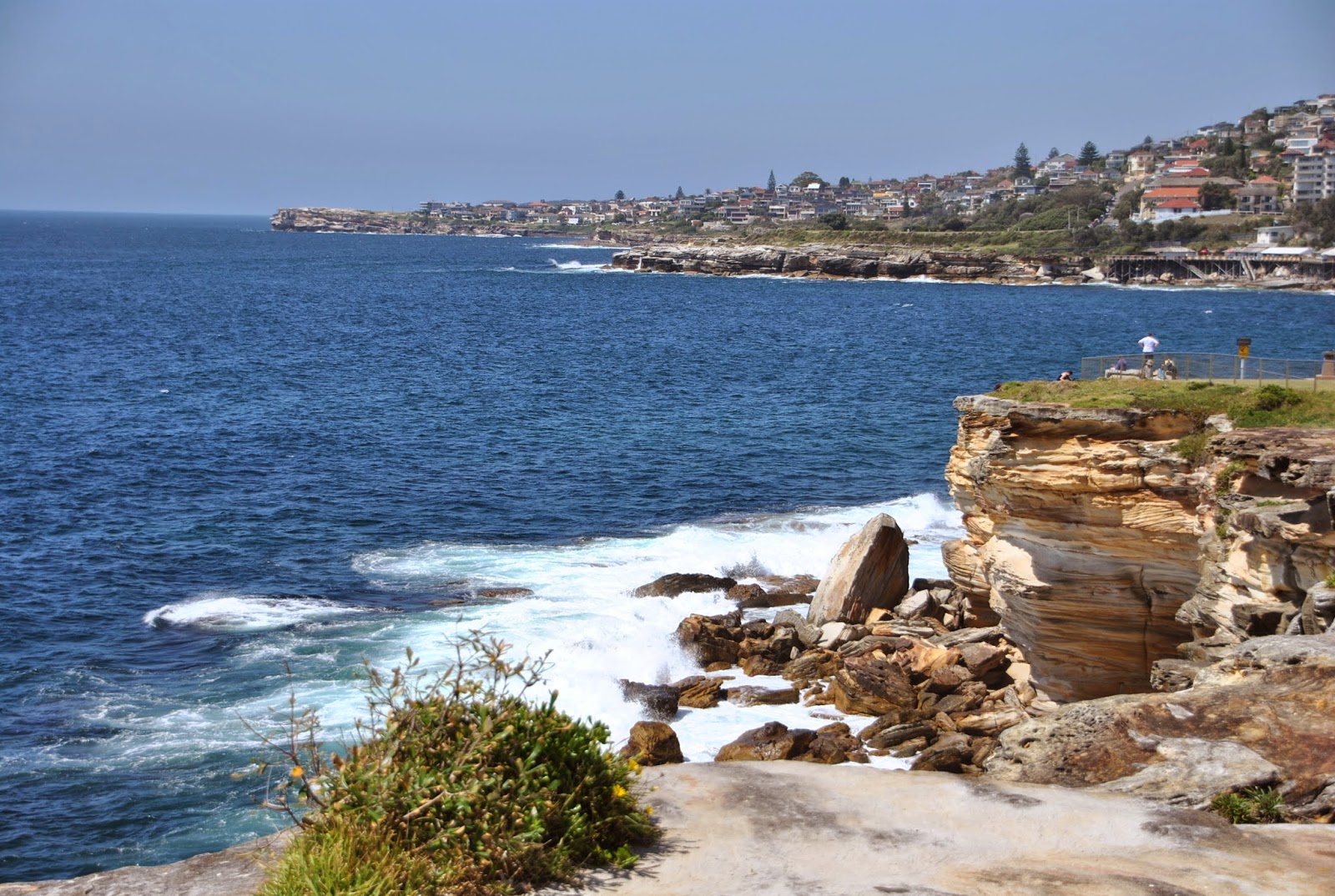
The bus system is actually pretty easy to use if you know where you need to go (and especially if you have help from the concierge), and most of them end up at Circular Quay, so we had no trouble finding the bus. We were the last ones off at Coogee and the driver was quite helpful in pointing the way to the Coastal Walk path. We started at 10:55 a.m. and expected the walk to take about 2 hours or so at a leisurely pace. It certainly was nice, following the cliffs, skirting some of the neighbourhoods on the south side of Sydney, and passing through a number of beaches and coves. Here are some pictures:

The Walk is on top of the cliff by the white fence

Coogee Beach


The Waverely Cemetery, the most picturesque in the world.
Headstones date back to the 1930s


Bondi Beach from the point

By the time we finished we were sure that the 25° was over 30° and the clouds had all but disappeared. Even though we had both taken water bottles that we refilled along the way at the public fountains (there are even dedicated taps for filling bottles - great idea for this kind of weather), we were both pretty wiped out. Nobody told us that there was NO shade anywhere on the walk, and, from the photos you can see that there are numerous staircases and inclines, so even though we didn't rush at all, and took some time to rest, we were never so happy as when we found the dark, relatively cool interior of the Bavarian Cafe at Bondi and ordered something very cold, very large and very wet to rehydrate our bodies.

At that point it was only just 1:00, but neither of us was hungry, so we abandoned the idea of Doyle's (there will be other opportunities before we come home) and just took the bus back to Circular Quay, a ride of about half an hour. So we did manage to finish the walk in about 2 hours. We determined later that we walked about 8.8 km, or over 5 miles! Here's the map:

We walked the entire yellow highlighted
section! Looks longer than it felt.

On the way back to the hotel we decided to stop for a light lunch and discovered a little place on a street called Nurses' Walk. It was so named because it ran along the back of the first hospital in Sydney.

The explanatory signpost. The verandah in the
background is where we had lunch.


While we were eating, these two wild
parakeets flew in looking for a handout.
They hung around for a few minutes and
then took off. Gorgeous colours!

In the evening, we thought we'd use the ferry tickets (that are good until 4:00 in the morning on the day after purchase) and go over to Darling Harbour for dinner. We wandered along Cockle Bay, which is the real mecca of harbourside dining in the city, and found Blue Fish, a restaurant we had been to on our last visit, and had a delicious fish dinner. We took the ferry back and got these beautiful shots of the bridge, opera house and Luna Park on the way:


The main entrance to Luna Park, Sydney's
amusement park right by the bridge


And so ended yet another day that ended up a lot more strenuous than first expected. But nobody can say we're not getting our exercise. Step count: just short of 21,000 according to our FitBits!! Saturday was our day in Hunter Valley Wine Country. We were being picked up for the tour at 7:30, so we weren't up for too long once we got back to the room.