Wednesday, March 7, 2018

Pacific Island Hopping - Part 2


Our next island stop after Guadalcanal was Gizo, also in the Solomon Islands. This island has very little, if any, military history significance, and it was really being used as another beach day. Unfortunately, again, our tour - a day at a local resort, with lunch and swimming - was cancelled due to low numbers, and the descriptions of the other tours really didn't attract us much.

Gizo was a tender port, and once we found out that the tender ride was 30 minutes each way, we thought we'd investigate a little before deciding if we wanted to go ashore. So Larry 'googled' Gizo and discovered how small the town was and that there was very little to even look at. That was why all the other tours involved a boat ride to another island!

So Gizo was again turned into an 'in-port sea day' where we got in some more laps and that sort of thing. The people we talked to later in the day told us that the islands where the tours went were nice, but there wasn't much to see, even underwater; but a few who had bargained locally were taken to some really nice spots and saw quite a bit of fish life while snorkeling. We did, however, get some beautiful photos of Gizo and the surrounding islands.

Gizo Island. The tenders had to go around that
huge coral shoal, making for a long ride

Nearby islands. Some of the excursions went to the
more distant of these.


As the day progressed, the sea green of the shallows
seemed to get brighter.

And for those of you looking, it seems the end of
the rainbow is at Gizo. It didn't last more than 5 minutes;
we were lucky to get this picture.


After leaving Gizo, we decided to have dinner at the Sushi Bar in Silk Road. With only 540 passengers on board for this segment of the world cruise, the specialty restaurants are not that busy, and it is usually quite easy to get a last-minute reservation. We had a great time there, and our chef introduced us to a few menu items that we hadn't tried before.

The Sushi Bar. It's fun to watch the chefs create the various
kinds of sushi for people at the bar and in the rest of Silk Road

Scallop sashimi

The House Special roll

Salmon and tuna tartares

We'll have to get there one more time before the additional 200 people board the ship in Manila.

On Saturday afternoon we arrived at our next port, Rabaul, Papua New Guinea, which was a major Japanese harbour during the WW II Pacific Campaign. Since Guadalcanal was a washout, Larry was hoping for a good military tour here. Monica was visiting the local volcano, Tavurvur, which is still quite active, having had its last major eruption in 1994.

The boat dropping off our pilot

A first pass of Tavurvur Volcano

Looking out across the bay

The port is a very run-down little town, but that's mainly because of the 1994 Tavurvur eruption that practically destroyed the place. After that, the capital of the island of New Britain was moved to the other side, far enough away, and there's been very little done to improve the infrastructure since. There are still a couple of industries in Rabaul - the gas distribution centre, and the Go-Go Cola plant (tastes like Coke), fortunately not too close to each other - and for the 7 ships that visit every year, tourism associated with Tavurvur.

Views  over the town of Rabaul from our verandah. There's not much
more than this to it.

As Larry learned, much of the island of New Britain
is covered with coconut palms, so coconut is a main export,
as is the coconut husk, which is ground down to make
fuel.
It is not the safest place for visitors. The local hotel is entirely gated, and there were very strong suggestions made on  the ship that no-one, including crew, leave the ship at night unless they were on a ship's tour. There was one, to a Fire Dance put on by one of the local tribes, on Saturday night. Over 100 from the ship went to see it, but many were saying that they couldn't see much, and it became quite repetitive after about the first 20 minutes. They stayed for about an hour and then headed back to the safety and air conditioning of Crystal Serenity.

Those of us who remained on board had a treat of our own - a local traditional dancing presentation that took place in the Galaxy Lounge. We had been talking to Maria, the Bar Manager, earlier in the day and she mentioned that Crystal likes to provide refreshments for local groups coming on board to perform. They usually take the amount of sandwiches that they would make for the same number of guests and double it...this time they were expecting to triple the amount they made. Good thing, because over the course of the day the number of performers kept going up - first it was 26, then it was 34, and just before dinner it was upgraded to 53!!! And it sure looked like all 53 were on stage at the end.

Tribal dance and song. There are over 400 different
tribes in Papua New Guinea, and at least 50 just on
New Britain.

The Mask Dance.

The entire cast taking a bow at the end of the performance.


Make sure you watch this video - we won't tell you what it is, but know that you may never listen to this song the same way again:


Sunday morning actually dawned nice enough to go on tour, unlike some of our previous ports. Monica headed off to the volcano and Larry's tour visited the military sites - and the hot springs near the volcano.

Just riding around town was an adventure, as the paved roads were full of potholes and the small buses spent much of their time weaving around them. In fact, it was so bad that in one spot one of the other buses on Monica's tour actually lost an entire wheel, not just a tire, and had to be replaced. Fortunately the new bus arrived in about 2 minutes and everyone carried on.

The first stop on the tour was to see the hot springs flowing out into the bay. The water is heated to boiling underground by the volcano, and escapes through a couple of large vents. The steam from this spring is visible from town, a good 15 minute bus ride away beyond the local lagoon.

Another view across the bay to Tavurvur

The hot spring. The water is about 100 degrees C when it spills
out from underground

A closer view. The spring 'river' is full of little vents
spewing out superheated water. One of the ladies on Larry's
tour wanted to see how hot the water was (??!) and was
stopped just in time from getting 3rd degree burns on her fingers!
After that, a hike up and down some dunes of volcanic matter went closer to the base of the volcano, and there was an option to trek all the way to the top to see the crater. After watching some other hikers making their way up the narrow and steep passage, and seeing storm clouds brewing over the island, Monica decided to give that a pass. Vertigo, narrow loose stone pathways and rain are not the greatest combination.
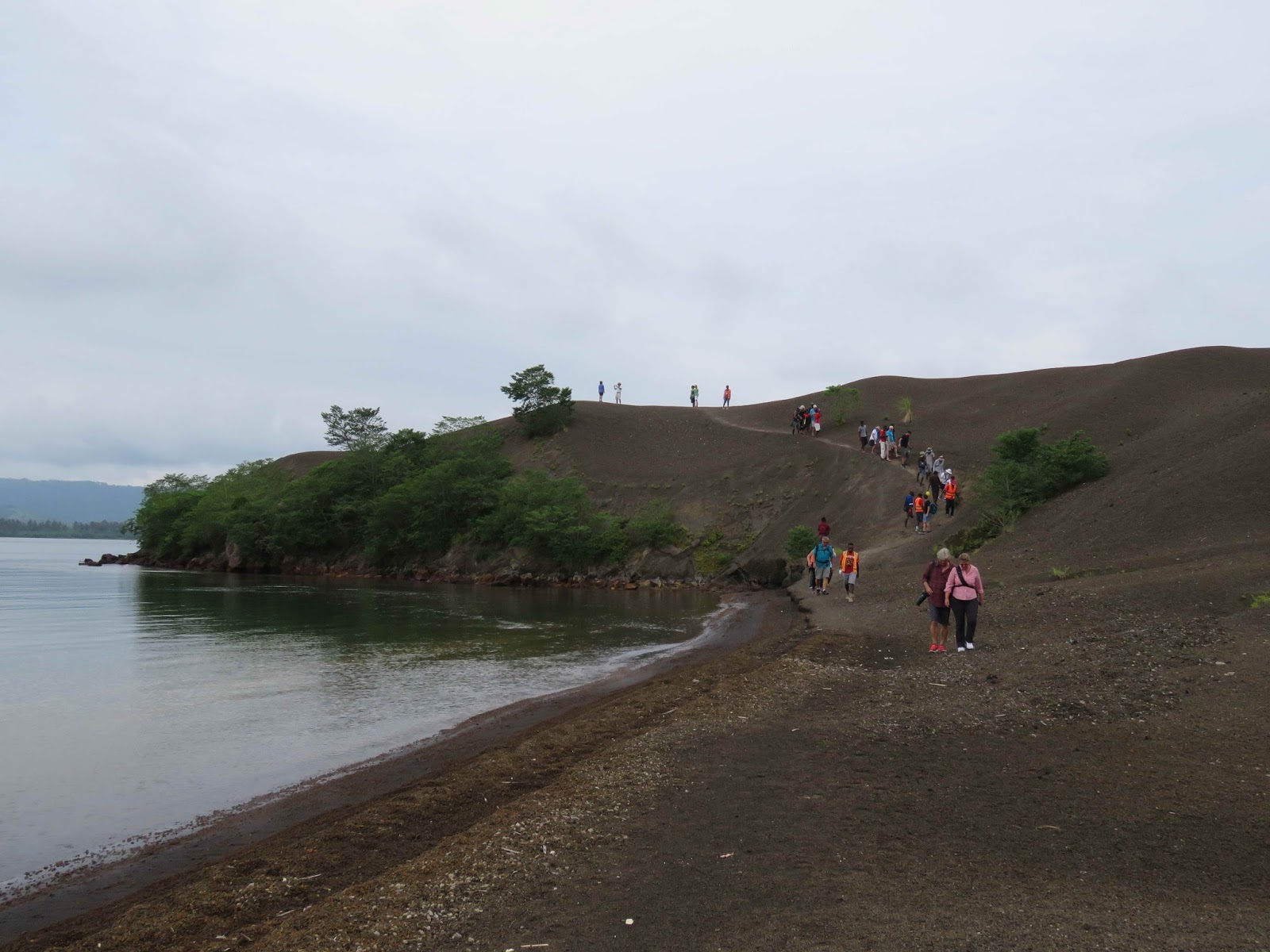

Walking toward the volcano. This is all volcanic material, crunchy
and quite loose. It was a real challenge to get over some of
these dunes.


Passing a pond on the way

A view of the climbers from our tour making
their way up the volcano. At times
they had to climb in a human chain, holding
hands, because it was so steep.


Going back toward the meeting point and parking lot.

It did in fact rain quite heavily in a brief thunderstorm before the group of climbers got back down to flat-ish ground, and they were all soaked by the time they returned to the meeting spot.

Just before the rain hit, Larry's tour also stopped at the hot spring, and one of our fellow guests, Tom, offered to take a photo for us:


Monica's tour was over at that point, and headed back to the ship, where the climbers were ready to get out of their wet clothes, put on bathing suits, and sink into the Jacuzzi hot tubs by the pool to ease their tired muscles.

Larry's tour turned out to be something of a disappointment. Leaving the hot springs just as the rain hit, the roads went from being barely driveable to mostly flooded, which made avoiding the massive potholes even more fun! The tour continued to see "aircraft wrecks" from the war that were a mass of metal that could have been anything, and probably were. Then on to Admiral Yamamoto's Bunker which is located at what is currently the New Guinea Club, but had been the site of Japanese headquarters. Rabaul had been a major air/sea base until 1944 and Yamamoto used it as his forward headquarters. It was from the nearby airfield his flight took off when he was shot down and killed in 1943. At one time the Club had large collection of war artifacts, but they were destroyed in the 1994 eruption, leaving just a few pieces.

Overlooking Rabaul from the volcano monitoring station above town.

Seismographs at the monitoring station

Crystal Serenity in port

A piece of a Japanese Oscar fighter plane

Inside 'Yamamoto's Bunker'. Not much there but some
Japanese characters uncovered on a wall.

Monica has been continuing to go to the Knitting group and the Watercolour Art classes. Here are a couple of pictures of projects she's done so far. That's not everything - there will be a show on our last sea day of work from both the knitting and art classes, and we'll post more then.

'Early work' - the Whitsunday Islands

A flower garden  that incorporates some Australian Aboriginal motifs

One of Monica's favourites so far.

Knitted market bag. It's bigger than it looks here, and
it stretches to hold quite a bit.

We're now heading into a stretch of 5 sea days before our next port of Boracay, Philippines. Many people have been looking forward to this, although there are always some who dread being away from land for that long. We are in the former category - there are lots of lectures and activities planned; we'll try to give you a sense of them in our next post.


Thursday, March 1, 2018

Pacific Island Hopping - Part 1

After leaving rainy Cooktown behind, we spent Sunday on a leisurely sea day cruising in brilliant sunshine across the Coral Sea on our way to Alotau and Kitava, our first two island stops in New Guinea. The day included the usual array of speakers for Larry, along with the knitting group and art class for Monica. The highlight of the day was the Sunday Brunch Buffet set up in Crystal Cove, the main lobby of the ship.

Keeping to the 'Down Under' theme, a koala ice sculpture on
a dessert station

Bar Manager Maria peeking out from
behind the kangaroo

Part of the sweet table

Monday morning found us in Alotau, New Guinea on the extreme southeastern tip of the country. We awoke to the news of a 7.5 magnitude earthquake overnight Sunday/Monday in Central New Guinea, but you would never have known it. When we did get off the ship later in the morning for our tour we found that while all the passengers knew about it, the locals knew nothing about it.

Looking out over Alotau from the ship after we arrived, the word "ramshackle" came to mind. The town stretches along the shore of Milne Bay and was the site of a small, but significant, battle between the Japanese and the Australians/Americans in 1942. It is generally acknowledged as the first battle the Japanese lost in the Pacific campaign. The town has more or less grown out of the remnants of the large Allied base that was established in the area during the war. According to our guide, to this day locals find remnants of the battle and the base overgrown in the surrounding jungle, or dug up when they plow a new field or start a new building.

One of the homes on Alotau. Most of the buildings looked
straight out of an old war movie

Overlooking the town and Milne Bay


Down by the waterside

Fishing boats


Our tour today was A Lesson in Papua New Guinea Cooking, and after a brief drive around the town, such as it is, and a brief photo stop at a "scenic" overlook, we arrived at the Masurina Lodge. On the drive up we learned the lodge was owned by the father of our driver, and had been in his family for several generations. In fact, his Great, Great Grandfather had been one of the original missionaries to arrive on the island.  We were not sure what to expect from this tour, but the lodge was not it, a sentiment expressed by all ten people on the tour.

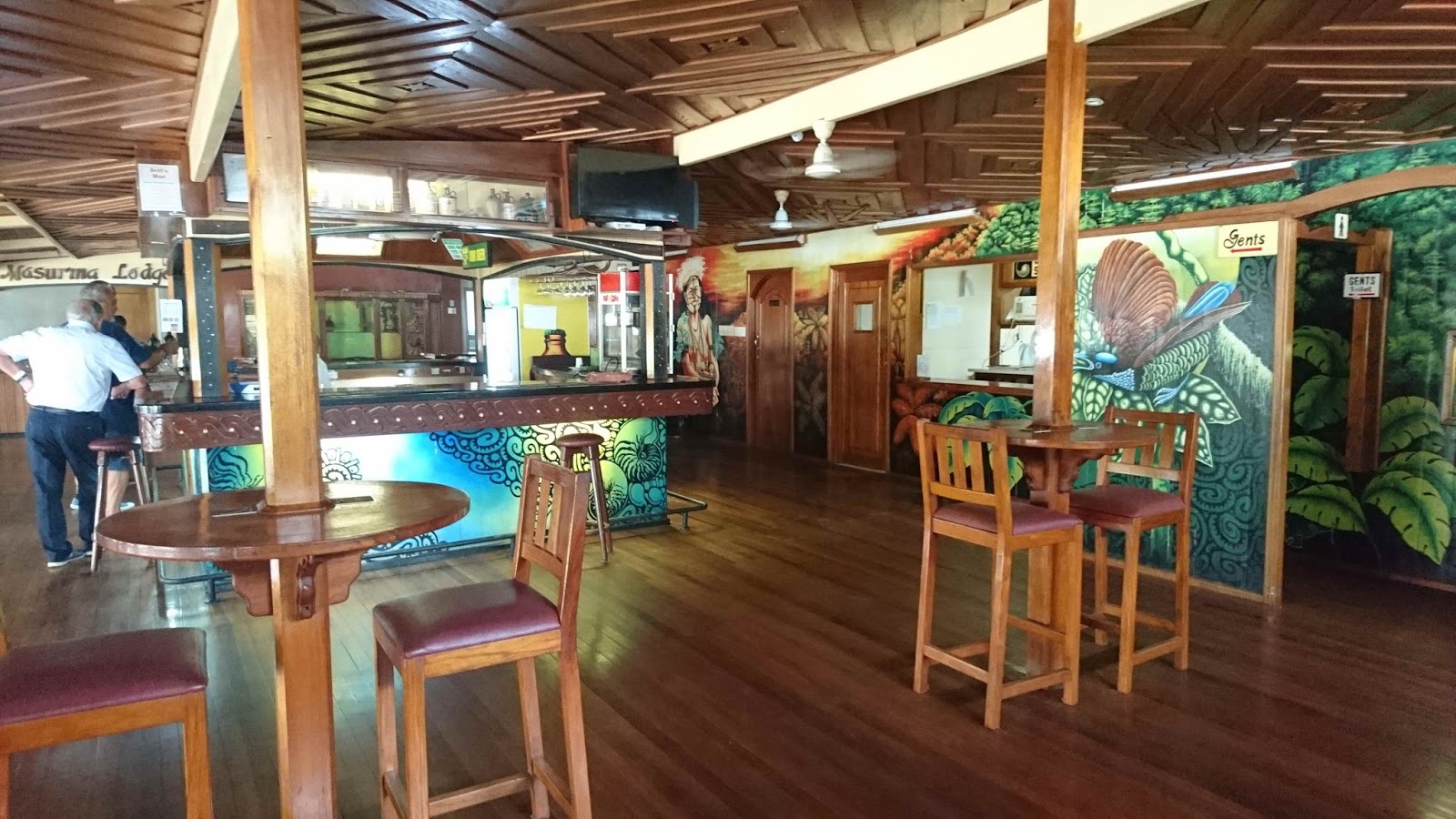
The bar at Masurina Lodge


The lesson was hands-on participation in preparing a typical PNG lunch of chicken, pork belly and fish with mixed local vegetables and coconut, steamed in large clay pots. The ingredients are layered in the pot, wrapped with banana leaf and then normally dropped into a bed of coals. The lodge cooks them on a stove top. Each person was given an apron and a food station with ingredients to prepare. Monica got the onions and garlic, while Larry got to assist one of the sous-chefs in scraping out freshly cracked open coconut, and yes, that seat is as close to the floor as it looks!!

Welcome drinks - fresh coconut or a combo of freshi
grated coconut and pineapple juiice. Even Monica liked it!

The ingredients table

Larry hard at work scraping cocounts

Filling one of the clay pots

Ready for the coconut juice to go on top


Final prep - coconut juice, and then wrapping
in banana leaf, below


 Once the pots were taken to the kitchen we all adjourned to the very comfortable, but very hot, (did we mention it was 33 C and humid??) bar/lounge area until lunch was served in the (thankfully!!) air conditioned dining room.

The buffet - fish, chicken and pork done with vegetables in the pots,
with jasmine rice


Returning to the ship after lunch, we spent a leisurely afternoon onboard.

Leaving Alotau


Tuesday dawned another cloudless, sunny day and found us anchored off the island of Kitava. At his lecture on Sunday, Destination Lecturer Ken Rees described Kitava as an island with about 2000 residents, and ONE motorized vehicle. Basically this was a "day-at-the-beach" stop, so after a leisurely beginning of the day, we set off by tender to walk the beach. And it looked like all 2000 residents had come out to greet us,  the older ones selling local knick-knacks and souvenirs (all made in China according to Ken!), and not one, but FOUR groups of school children singing to raise money for their schools. Apparently having babies is the only "industry" on the island as the 2000 people seemed evenly split between children and adults!!! And lots of dogs and puppies as it seems even the pets get in on the act!! So, after Monica went in for a swim, and we walked the beach taking pictures, we headed back to the ship. Another "Been-There-Done-That" box ticked in our travelogue!! And after all that exertion, we spent the rest of the day both at the pool and doing our laps on the Promenade Deck!

The beach and island across. For $5 the locals would give
you a ride across on their outrigger rafts.

The beach was quite busy in the morning


Schoolchildren doing their dance to fundraise from
the visitors


Kitava and little sister island. What beautiful views!

Our guest chef, Scott Webster, was still on board, scheduled to do another cooking demonstration on Wednesday morning. While we were up in Palm Court on Tuesday evening, we were invited to have dinner with Scott and his wife along with another couple we had chatted with a few times. We ended up at Prego for about 3 hours, and had a great time talking about food and travel. As we had mentioned before, Scott is one of the best-known chefs in Australia and his restaurant in Singapore, OSIA, is good enough to merit a Michelin star. When we mentioned that we would be in Singapore, he offered to contact his team there to get us a reservation. We're waiting for a response to the email he sent them, to see if we will be able to get in to the Sunday Brunch he highly recommended. Wonder what a reservation request from the boss himself will get us??? More on that later, but we can show you a few courses from a particular menu he presented:

Murray Cod Cvice

'Jumbuck in a Tucker Bag' - or lamb loin in puff pastry,
one of his signature dishes


For those chocoholics out there - Valrhona chocolate soup with
black pepper ice cream

Wednesday was spent at sea, cruising the Solomon Sea on our way to the island of Guadalcanal in the Solomon Islands. Another hot, but very hazy (an omen of things to come??) and humid day spent in the usual way, in lectures and other activities.


Scott's presentation on alternate methods - cervice, curing
and sous-vide cooking


The final dishes - he also distributed
recipe cards, so we will try these at home!

Monica also went to the spa for her first mani/pedi of the cruise in preparation for the second Formal Night. Three of our tablemates are on the full World Cruise, a couple from Michigan (and a few other places including just outside Grand Bend!!) and an older woman from Ohio travelling on her own. Jon (from Michigan) was a semi-professional saxophone player about 40 years ago, and has been playing informally with the Crystal Quartet at the pool on sea days. By a serendipitous sequence of events, he was invited to join the Show Band for tonight's Sounds of Motown show, and to play in a three-sax solo performance during the show! To say he was as nervous as a cat in a rocking chair factory at dinner....... The show was a huge success, and we loved it so much we went to both the 8:30 and 10:30 shows, with a stop in The Avenue Saloon in between!!

Jon doing his solo with the other horn players. He sure looked
like he was having a great time!

Mini jam at the end of the show


And so here we are today, Thursday March 1, in Guadalcanal. This was the site of probably the most important of the WW II island campaigns, the place where the Japanese suffered their biggest early defeat in the war. Today was to be the highlight of this cruise for Larry. We had booked the 2017 cruise in part because it came here, and when we had to cancel last year, we re-booked this year because it was coming here. You will note the "was" above?? The pictures below describe our day at Guadalcanal, taken at 8:00 AM, Noon and 4:00 PM. Yes, the tours were cancelled and we spent the day on the ship watching the rain fall - and dodging raindrops to get in some more laps around the Promenade deck. And yes, Larry is very disappointed, but it gives us a reason to come back some day.

8:00 a.m. view

12:00 noon view


4:00 p.m. view - finally looking nice...

...as we were leaving, And at least we got to sail over some of the history. This is Iron Bottom Sound, which was the area where the four major naval battles of the Guadalcanal campaign were fought. It used to be called Sealark Channel, but now it is the final resting place of almost 30 American, Australian and Japanese warships of various sizes, not to mention hundreds of aircraft.


The far distant spit of land is Lunga Point and the major historic sites are on the other side of it, so this is as close as we got. Speaking to a couple who went on the Panoramic Tour, they told us the roads beyond the point were closed due to mudslides, so even if we had gone on the Battlefields Tour we would not have been able to get anywhere close.